Introduction
The practice of elevating a vehicle on four jack stands represents a fundamental safety protocol within automotive maintenance and repair. This method is employed to securely suspend a vehicle, allowing unobstructed access to the undercarriage for inspection, servicing, and component replacement. While seemingly straightforward, the process demands adherence to stringent engineering principles and safety standards to prevent catastrophic failure. This guide details the material science behind jack stand construction, the critical engineering considerations for load distribution, potential failure modes, and relevant industry best practices. The core performance metric centers around static load capacity, stability under dynamic loads, and resistance to deformation or fracture. This detailed analysis addresses the persistent industry pain point of ensuring worker safety during extended under-vehicle operations, mitigating risks associated with inadequate support, and optimizing workflow efficiency through reliable lifting solutions.
Material Science & Manufacturing
Jack stands predominantly utilize steel, specifically carbon steel alloys (AISI 1045, AISI 1018) due to their high yield strength and relatively low cost. Higher-end jack stands may incorporate alloy steels (4140, 4130) for increased tensile strength and toughness. The manufacturing process begins with raw material sourcing, followed by forging or casting of the stand’s core components – the base, column, and saddle. Forged steel offers superior grain structure and impact resistance compared to cast steel. Critical parameters during forging include precise temperature control to avoid grain growth and controlled cooling rates to minimize residual stresses. Welding, typically shielded metal arc welding (SMAW) or gas metal arc welding (GMAW), joins these components. Weld integrity is paramount, requiring qualified welders and adherence to AWS D1.1 structural welding code. Post-weld heat treatment (PWHT) is often implemented to relieve stresses and improve ductility. Saddles, the contact point with the vehicle, frequently incorporate high-density polyethylene (HDPE) or polyurethane padding to prevent damage to the vehicle's chassis and enhance grip. The chemical compatibility between the steel and polymeric padding must be verified to prevent degradation over time. Powder coating provides corrosion resistance and a durable finish, with epoxy-based coatings offering superior protection against salt spray and environmental factors.
Performance & Engineering
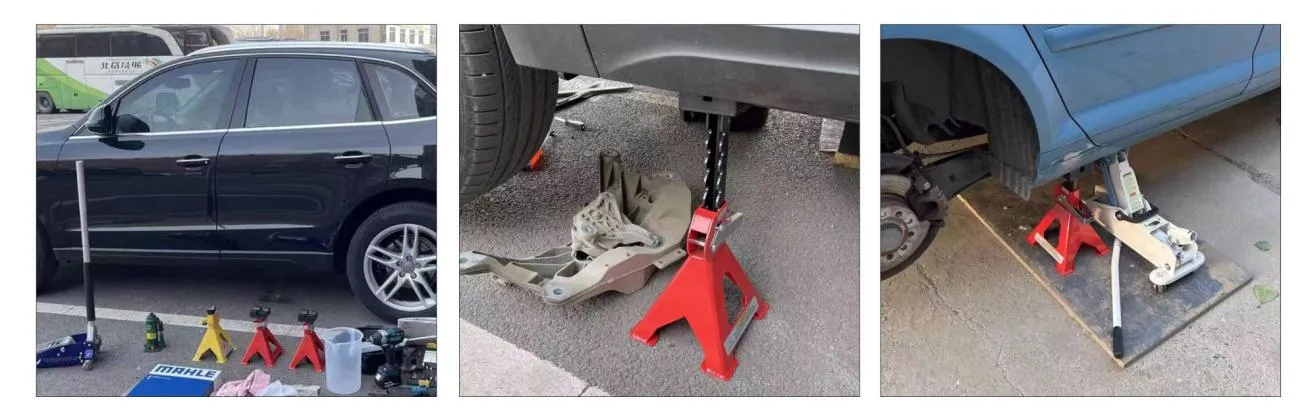
The engineering of jack stands focuses on force analysis to ensure structural integrity under load. Each jack stand must safely support at least half the vehicle’s weight, accounting for dynamic loads during movement or work performed on the vehicle. Finite Element Analysis (FEA) is routinely employed during the design phase to model stress distribution and identify potential weak points. Buckling analysis is crucial for the column design, ensuring it resists lateral instability. The base geometry is designed to maximize stability and prevent tipping, with a wider base providing greater resistance to overturning moments. Compliance requirements, such as those outlined by ASME B20.1 (Safety Standards for Lifting Devices), dictate minimum safety factors and testing procedures. Environmental resistance is a key consideration; jack stands are exposed to corrosive elements like road salt, moisture, and automotive fluids. Material selection and protective coatings are crucial to mitigate corrosion and maintain structural integrity over the lifespan of the product. The saddle design incorporates a locking mechanism, often a ratcheting pawl and gear system, to securely position the stand at various heights and prevent accidental lowering. This mechanism’s performance is directly tied to the quality of heat treatment and material hardness of the engaging components.
Technical Specifications
| Load Capacity (per stand) | Minimum Height | Maximum Height | Base Diameter |
|---|---|---|---|
| 3 Ton (6,600 lbs / 3,000 kg) | 11 inches (280 mm) | 15.75 inches (400 mm) | 7.87 inches (200 mm) |
| 2 Ton (4,400 lbs / 2,000 kg) | 8.5 inches (216 mm) | 12.6 inches (320 mm) | 6.3 inches (160 mm) |
| 6 Ton (13,200 lbs / 6,000 kg) | 14 inches (356 mm) | 20.5 inches (521 mm) | 9.84 inches (250 mm) |
| 3.5 Ton (7,700 lbs / 3,500 kg) | 12 inches (305 mm) | 17 inches (432 mm) | 8.27 inches (210 mm) |
| 2.5 Ton (5,500 lbs / 2,500 kg) | 9.5 inches (241 mm) | 14.2 inches (361 mm) | 6.7 inches (170 mm) |
| 5 Ton (11,000 lbs / 5,000 kg) | 15.5 inches (394 mm) | 22 inches (559 mm) | 10.6 inches (270 mm) |
Failure Mode & Maintenance
The primary failure modes of jack stands include yielding of the steel due to overload, buckling of the column under compressive stress, fracture of welds, and failure of the locking mechanism. Fatigue cracking can initiate at stress concentration points, particularly around weld joints and the base. Corrosion, especially in regions exposed to road salt, weakens the steel and accelerates crack propagation. Creep, the slow deformation under sustained load, can occur over extended periods. Delamination of the saddle padding reduces grip and increases the risk of slippage. Maintenance primarily involves regular inspection for signs of corrosion, damage, or wear. Welds should be visually inspected for cracks or porosity. The locking mechanism should be tested to ensure proper engagement and disengagement. Lubrication of moving parts prevents corrosion and ensures smooth operation. If corrosion is detected, the stand should be thoroughly cleaned, and the affected areas treated with a corrosion inhibitor. Stands exhibiting any signs of structural damage or weld failure must be immediately removed from service. Periodically, a load test (applying a load slightly below the rated capacity) can verify structural integrity. Documentation of inspections and maintenance is critical for tracking stand condition and ensuring safety compliance.
Industry FAQ
Q: What is the appropriate safety factor for jack stand selection?
A: Industry standards, such as ASME B20.1, typically require a minimum safety factor of 4:1 for static load applications. This means the jack stand’s rated capacity should be at least four times the weight it is intended to support. A higher safety factor is recommended for dynamic loads or applications where there is a risk of impact.
Q: How do I determine the correct jack stand height for my vehicle?
A: Select jack stands with a height range that allows you to securely support the vehicle at designated jacking points without overextension or compression. The stand should be adjusted to a height that provides ample clearance for the task at hand while maintaining a stable posture.
Q: What are the risks associated with using mismatched jack stands?
A: Using jack stands with different load capacities or heights creates an uneven support structure, increasing the risk of instability and potential collapse. Always use a matched set of jack stands with identical specifications.
Q: What is the impact of surface conditions on jack stand stability?
A: Uneven or soft surfaces can compromise jack stand stability. Always use jack stands on a hard, level surface. If the floor is uneven, use shims to create a stable base. Avoid using jack stands on asphalt or concrete that is cracked or deteriorated.
Q: How often should jack stands be inspected and replaced?
A: Jack stands should be inspected before each use for signs of damage, corrosion, or wear. They should be replaced if any structural defects are identified or if they have been subjected to overload. A scheduled inspection program, with documentation, is highly recommended.
Conclusion
The reliable and safe operation of a vehicle supported by four jack stands hinges upon a confluence of robust material selection, precise manufacturing processes, and diligent adherence to engineering principles. Understanding the potential failure modes – from steel yielding to weld fracture – is paramount for preventative maintenance and ensuring worker safety. The inherent stability of the system relies not only on the individual jack stand's capacity but also on the proper application of these stands on a level, robust surface, coupled with a comprehensive understanding of load distribution.
Moving forward, advancements in jack stand design may incorporate integrated sensors for real-time load monitoring and automated locking mechanisms for enhanced security. The ongoing refinement of alloy compositions and protective coatings will further improve corrosion resistance and extend product lifespan. Continued emphasis on training and adherence to industry best practices, as outlined in standards like ASME B20.1, remains critical for mitigating risks and optimizing the safety and efficiency of automotive maintenance operations.
