Introduction
Rolling car jack stands are essential components in automotive maintenance and repair, providing a stable and secure platform for supporting vehicles during work. Positioned within the automotive lift equipment category, they serve as a critical safety device complementing hydraulic floor jacks. Unlike fixed jack stands, rolling varieties enhance user maneuverability, especially in confined spaces, due to their integrated caster wheels. Core performance characteristics center around load capacity, stability under load, ease of adjustability, and durability. The increasing complexity of vehicle chassis and the demand for more efficient repair procedures drive the ongoing evolution of jack stand design, focusing on enhanced safety features and ergonomic considerations. A key industry pain point is ensuring consistent load rating adherence across manufacturers and combating counterfeit products with substandard materials and construction.
Material Science & Manufacturing
The primary material in most rolling car jack stands is carbon steel, specifically AISI 1008 or 1018, chosen for its balance of strength, weldability, and cost-effectiveness. The steel undergoes a manufacturing process typically involving cold-rolled steel sheet, providing a smoother surface finish and tighter tolerances than hot-rolled alternatives. Critical load-bearing components – such as the saddle, upright supports, and base – are frequently fabricated from thicker gauge steel (e.g., 10-14 gauge) to withstand substantial compressive forces. Caster wheels are generally constructed from polypropylene or polyurethane, selected for their abrasion resistance, load capacity, and ability to roll smoothly on concrete or asphalt surfaces. Manufacturing processes include stamping for base and saddle components, robotic welding for structural assembly, and roll forming for the upright supports. Parameter control is paramount; welding parameters (current, voltage, wire feed speed) are rigorously monitored to ensure weld integrity and prevent defects like porosity or undercut. Steel surface preparation – including degreasing and phosphating – is crucial for subsequent powder coating to enhance corrosion resistance. Powder coating typically utilizes epoxy or polyester-based formulations, applied electrostatically and cured at elevated temperatures (180-200°C) to create a durable, protective finish. Quality control involves dimensional inspection, non-destructive testing (NDT) like ultrasonic testing or magnetic particle inspection on critical welds, and load testing of finished assemblies.
Performance & Engineering
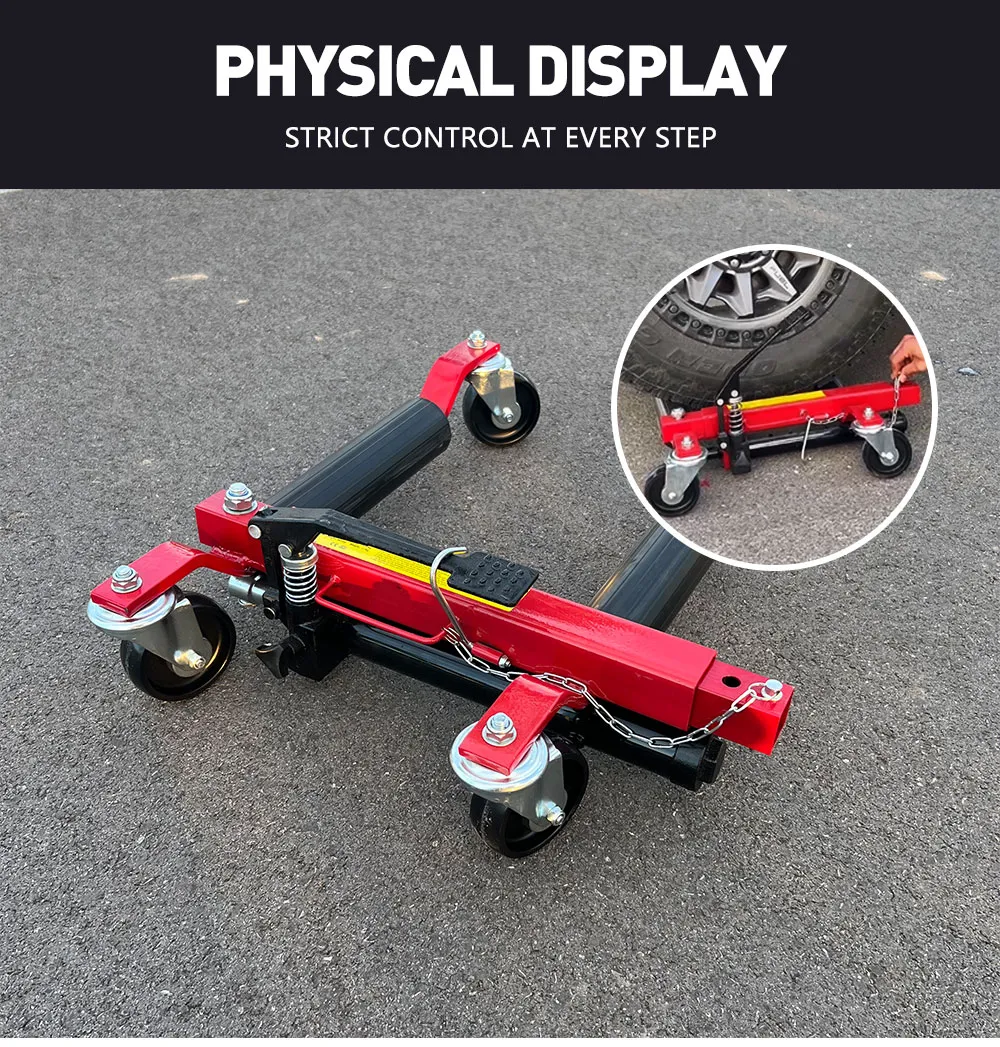
The performance of rolling car jack stands is governed by fundamental principles of structural mechanics and materials science. Force analysis focuses on compressive stress within the upright supports and saddle, as well as shear stress at weld joints. Stability is critical, and designs incorporate a wide base to maximize resistance to tipping. The height adjustment mechanism, often a pin-lock system, must securely lock at each position to prevent unintentional collapse. Finite Element Analysis (FEA) is frequently employed during the design phase to simulate stress distribution under various loading conditions and optimize component geometry. Environmental resistance is addressed through corrosion protection measures, including powder coating and the use of corrosion inhibitors. Compliance requirements, such as those stipulated by ASME B30.23, mandate minimum load capacities and safety factors. Load capacity is directly related to the yield strength of the steel used and the cross-sectional area of the load-bearing components. A typical safety factor of 4:1 is applied, meaning the jack stand should withstand at least four times its rated capacity before permanent deformation occurs. Furthermore, the rolling mechanism must be capable of maintaining stability and maneuverability even with a full load applied, requiring careful consideration of caster wheel size, material hardness, and bearing design.
Technical Specifications
| Parameter | Unit | Typical Value (Single Stand) | Testing Standard |
|---|---|---|---|
| Minimum Load Capacity | tons (US) | 3 | ASME B30.23 |
| Maximum Load Capacity | tons (US) | 6 | ASME B30.23 |
| Minimum Height | inches | 16 | Manufacturer Specification |
| Maximum Height | inches | 24 | Manufacturer Specification |
| Base Width | inches | 24 | Manufacturer Specification |
| Base Depth | inches | 18 | Manufacturer Specification |
| Steel Grade (Upright/Saddle) | - | AISI 1018 | ASTM A36 |
| Caster Wheel Material | - | Polypropylene | - |
| Powder Coat Thickness | microns | 60-80 | ASTM D3359 |
| Adjustment Positions | - | 4-6 | Manufacturer Specification |
| Net Weight | lbs | 40-60 | - |
| Weld Strength (Minimum) | psi | 70,000 | AWS D1.1 |
Failure Mode & Maintenance
Rolling car jack stands are susceptible to several failure modes. Fatigue cracking, particularly at weld joints, is a common issue arising from repeated loading and unloading cycles. This is exacerbated by stress concentrations at geometric discontinuities. Corrosion, especially in environments with high humidity or exposure to road salts, can weaken steel components and lead to structural failure. Plastic deformation of the saddle or upright supports can occur if the load capacity is exceeded. Caster wheel failure, including bearing seizure or wheel detachment, can compromise stability and maneuverability. Delamination of the powder coating exposes the underlying steel to corrosion. Maintenance is crucial to prevent these failures. Regular inspection should include a visual check for cracks, corrosion, and damaged welds. Lubrication of caster wheel bearings with a suitable grease or oil ensures smooth rolling and prevents premature wear. Periodically tightening all bolts and fasteners maintains structural integrity. If corrosion is present, it should be addressed promptly by removing the rust and applying a protective coating. Jack stands subjected to heavy use or exposed to harsh environments should be retired after a predetermined service life (e.g., 5-7 years) or if any signs of structural compromise are detected. It is crucial never to exceed the rated load capacity and always to use jack stands in pairs on a level, solid surface.
Industry FAQ
Q: What is the significance of the ASME B30.23 standard, and how does it impact jack stand design and testing?
A: ASME B30.23 provides a comprehensive set of safety requirements for lifts and hoisting equipment, including jack stands. It specifies minimum load capacities, safety factors, marking requirements, and testing procedures. Manufacturers must design and test their jack stands to meet these requirements to ensure operator safety and product liability protection. Adherence to B30.23 demonstrates a commitment to quality and safety, and is often a prerequisite for acceptance by professional repair shops and regulatory agencies.
Q: What are the primary causes of jack stand failure in a professional automotive repair environment?
A: In professional settings, the most common causes of failure are exceeding the load capacity, improper use (e.g., on uneven surfaces), and inadequate maintenance. Repeated high-cycle loading contributes to fatigue cracking, especially in welds. Also, damage from impact (e.g., being bumped by vehicles or tools) can compromise structural integrity. Neglecting regular inspections and lubrication accelerates wear and tear, increasing the risk of failure.
Q: What material properties are most critical when selecting steel for jack stand construction?
A: Yield strength is paramount, as it determines the load-bearing capacity of the steel. Ductility is also important, allowing the steel to deform slightly under stress rather than fracturing abruptly. Weldability is crucial for ease of fabrication and ensuring strong, reliable weld joints. Finally, corrosion resistance, either inherent to the steel alloy or provided by a protective coating, is essential for long-term durability.
Q: How does the design of the caster wheel assembly affect the overall performance and safety of the jack stand?
A: The caster wheel assembly’s design directly influences maneuverability, stability, and load distribution. Wheel diameter affects the ease of rolling over obstacles. Wheel material (polypropylene vs. polyurethane) impacts abrasion resistance and load capacity. The quality of the bearings determines the smoothness of rolling and reduces the effort required to move the jack stand. A robust mounting mechanism is critical to prevent wheel detachment under load.
Q: What are the key considerations when evaluating the durability of a powder coating finish on a jack stand?
A: Key considerations include coating thickness, adhesion to the steel substrate, and resistance to chipping, cracking, and corrosion. ASTM D3359 testing evaluates coating thickness and adhesion. Salt spray testing (ASTM B117) assesses corrosion resistance. The type of powder coating formulation (epoxy, polyester, or hybrid) also influences durability; epoxy provides excellent adhesion, while polyester offers superior UV resistance.
Conclusion
Rolling car jack stands are critical safety components in automotive repair, demanding careful consideration of material selection, manufacturing processes, and performance characteristics. The industry's focus on safety, driven by standards like ASME B30.23, necessitates rigorous testing and quality control procedures. Understanding the potential failure modes – fatigue cracking, corrosion, and caster wheel failure – is essential for implementing effective maintenance protocols and ensuring long-term reliability.
Future advancements will likely focus on incorporating enhanced safety features, such as redundant locking mechanisms and integrated overload protection systems. The use of lighter-weight, high-strength materials, like advanced high-strength steels (AHSS), could further improve performance and reduce overall weight. Continued development of durable and corrosion-resistant powder coating formulations will be crucial for extending the service life of these essential tools, mitigating risk and optimizing operational efficiency in automotive repair facilities.
