Introduction
The tool chest trolley represents a critical component in modern industrial maintenance, repair, and operations (MRO). Functionally, it is a mobile storage unit designed to securely house and transport hand tools, power tools, and specialized equipment. Within the industrial supply chain, it occupies a position downstream of raw material production (steel, polymers) and fabrication (stamping, welding, molding), and upstream of end-user applications in sectors like automotive, aerospace, construction, and manufacturing. Core performance characteristics are defined by load capacity, durability, maneuverability, security features, and organizational efficiency. A primary pain point for industry is the balance between robust construction for demanding environments and the ergonomic factors affecting technician productivity and safety. Frequent concerns involve wheel failure, lock mechanism vulnerability, and inadequate organization leading to tool loss and downtime. The trolley's design and material selection directly impact operational efficiency and the total cost of ownership.
Material Science & Manufacturing
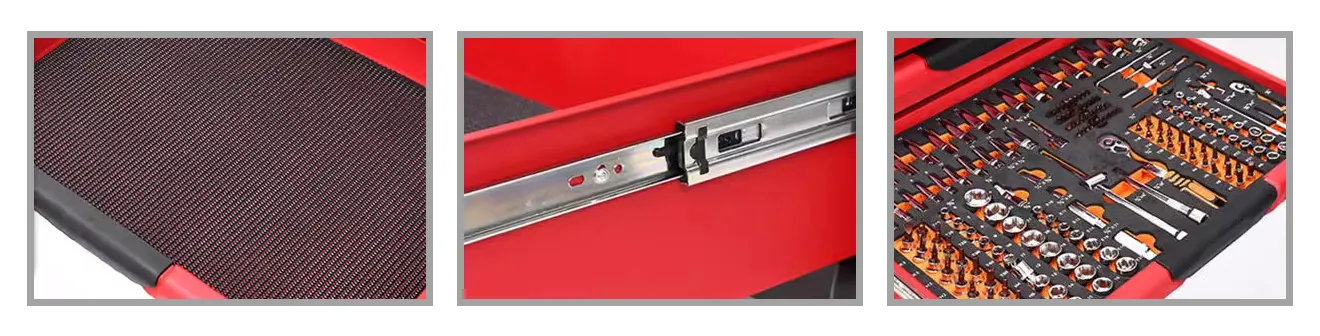
Tool chest trolleys are typically constructed from steel (carbon steel, stainless steel) for the cabinet body, drawers, and frame, and employ polymers (polypropylene, polyethylene, polyurethane) for drawer liners, handles, wheels, and impact-resistant corners. Carbon steel, often AISI 1008 or 1018, provides high strength and weldability, but requires corrosion protection via powder coating or galvanization. Stainless steel, such as 304 or 316, offers superior corrosion resistance, particularly important in humid or chemically exposed environments, but at a higher cost. Polypropylene, known for its high impact resistance and low density, is commonly used for drawer interiors. Wheels are frequently manufactured from polyurethane, offering a balance of load capacity, abrasion resistance, and low rolling resistance. Manufacturing processes include sheet metal fabrication (stamping, bending, laser cutting), welding (MIG, TIG), powder coating, and injection molding. Parameter control during welding is crucial to maintain structural integrity – pre-heat temperature, welding current, and shielding gas composition must be carefully monitored to prevent cracking and porosity. Powder coating thickness and curing temperature impact corrosion resistance. Drawer slide mechanisms are typically roller bearing or ball bearing assemblies, requiring precise tolerances for smooth operation and longevity. The manufacturing process often includes robotic welding for precision and repeatability, and automated powder coating lines for consistent finish quality. Quality control focuses on dimensional accuracy, weld soundness, coating adhesion, and wheel load capacity.
Performance & Engineering
Performance of a tool chest trolley is assessed across several key engineering domains. Static load capacity is critical, typically ranging from 500 lbs to over 1000 lbs, dictated by the gauge of steel used in the frame and drawer construction. Dynamic load capacity, which considers impacts and vibrations during transport, is less readily specified but crucial for preventing structural failure. Force analysis involves evaluating stresses on the frame, drawers, and wheel assemblies under various loading conditions. Finite Element Analysis (FEA) is frequently employed to optimize structural design and identify potential stress concentrations. Environmental resistance is a significant consideration, especially regarding corrosion. Salt spray testing (ASTM B117) is used to assess the effectiveness of corrosion protection coatings. Impact resistance is evaluated using drop tests and pendulum impact tests. Wheel performance is characterized by load capacity, rolling resistance, and abrasion resistance. Ergonomic factors, including handle height, drawer accessibility, and overall maneuverability, directly impact technician productivity and reduce the risk of musculoskeletal injuries. Compliance requirements vary by region; in the US, OSHA standards regarding tool storage and workplace safety apply. European standards (EN) may specify requirements for mechanical strength, stability, and materials safety. Locking mechanisms must meet minimum security standards to prevent unauthorized access to tools.
Technical Specifications
| Parameter | Unit | Standard Model | Heavy-Duty Model |
|---|---|---|---|
| Overall Dimensions (L x W x H) | inches | 48 x 18 x 36 | 60 x 24 x 42 |
| Weight (Empty) | lbs | 150 | 220 |
| Maximum Load Capacity | lbs | 800 | 1200 |
| Number of Drawers | - | 5 | 7 |
| Drawer Load Capacity (Each) | lbs | 75 | 100 |
| Wheel Diameter | inches | 5 | 6 |
| Steel Gauge (Cabinet) | mm | 1.2 | 1.5 |
Failure Mode & Maintenance
Common failure modes in tool chest trolleys include wheel bearing failure (due to overloading or contamination), drawer slide malfunction (caused by misalignment or lack of lubrication), corrosion of steel components (especially in high-humidity environments), locking mechanism failure (resulting from wear or damage), and structural fatigue cracking (typically at weld points or stress concentrations). Fatigue cracking often initiates from microscopic flaws in the weld or material and propagates under cyclic loading. Delamination of powder coating can occur due to poor surface preparation or inadequate curing. Oxidation of steel components, especially in coastal environments, can lead to significant corrosion. Regular maintenance is crucial to extend service life. This includes periodic lubrication of drawer slides and wheel bearings, inspection for corrosion (with application of rust preventative compounds as needed), tightening of loose fasteners, and inspection of the locking mechanisms. Wheels should be replaced when signs of wear or damage are observed. Annual inspection of weld points is recommended to identify potential fatigue cracks. For powder-coated surfaces, cleaning with mild detergent and water is sufficient; avoid abrasive cleaners. Preventative maintenance schedules should be established based on usage frequency and environmental conditions.
Industry FAQ
Q: What steel gauge is recommended for a tool chest trolley intended for heavy-duty industrial use with frequent transport over uneven surfaces?
A: For heavy-duty applications and frequent transport over uneven terrain, a minimum steel gauge of 1.5mm for the cabinet and frame is recommended. This provides increased structural rigidity and resistance to bending and fatigue. Consider reinforcing critical weld points with gussets or additional bracing to further enhance durability.
Q: What type of wheel material and configuration provides the best combination of load capacity, maneuverability, and floor protection?
A: Polyurethane wheels with ball bearings generally offer the best compromise. A wheel diameter of 6 inches or greater is recommended for high load capacities. Swivel casters, ideally with locking mechanisms, provide superior maneuverability. Consider non-marking polyurethane formulations to protect sensitive flooring surfaces.
Q: What is the expected service life of a powder-coated steel tool chest trolley in a moderately corrosive environment (e.g., a workshop near the coast)?
A: In a moderately corrosive environment, a properly powder-coated tool chest trolley can be expected to last 5-7 years with regular maintenance. However, annual inspection for corrosion and touch-up of damaged areas are crucial. Consider using a powder coating with enhanced corrosion resistance, such as epoxy-polyester hybrids.
Q: What is the significance of drawer slide load capacity, and how does it relate to overall trolley performance?
A: Drawer slide load capacity directly impacts the usability and longevity of the trolley. Drawers that are consistently overloaded will experience premature slide failure, leading to binding, misalignment, and ultimately, complete failure. A minimum drawer load capacity of 75 lbs is recommended, with 100 lbs or higher for drawers intended to hold heavy tools or equipment.
Q: What are the key considerations for selecting a locking mechanism for a tool chest trolley to prevent unauthorized access?
A: The locking mechanism should offer robust security features, such as a high-security cylinder with keyed-alike or unique keys. Consider features like central locking systems that secure all drawers simultaneously. The lock housing should be constructed from hardened steel to resist tampering. Regularly inspect the locking mechanism for wear and damage.
Conclusion
The tool chest trolley, while seemingly simple, is a complex engineered product crucial for efficient operations in a multitude of industries. Its performance is directly linked to material selection, manufacturing precision, and adherence to relevant engineering principles. Proper consideration of load capacity, environmental resistance, and ergonomic factors is vital to ensure durability, safety, and operator productivity. Selecting a trolley based solely on initial cost can lead to premature failure and increased total cost of ownership.
Future development trends are likely to focus on lightweight materials (e.g., aluminum alloys), integrated tool tracking systems (using RFID or barcode technology), and enhanced ergonomic features (e.g., adjustable height work surfaces). Improved corrosion protection technologies and more durable drawer slide mechanisms are also areas of ongoing innovation. A proactive approach to preventative maintenance, coupled with careful selection based on application-specific requirements, will maximize the lifespan and return on investment of a tool chest trolley.
