Introduction
Wheel jack stands are critical safety devices utilized in automotive repair and maintenance operations. Positioned beneath a vehicle after lifting with a jack, they provide a stable and secure support system, preventing collapse during work. Unlike hydraulic jacks which are intended for lifting only, jack stands are designed for sustained load-bearing. Their function directly addresses the significant safety risk inherent in working under elevated vehicles. The industry chain involves steel manufacturing, forging or casting, welding/fabrication, surface treatment, and final assembly. Core performance characteristics include load capacity, stability under load, and the reliability of the locking mechanism. The demand for robust and dependable jack stands is driven by both professional automotive technicians and DIY enthusiasts, making quality and adherence to safety standards paramount.
Material Science & Manufacturing
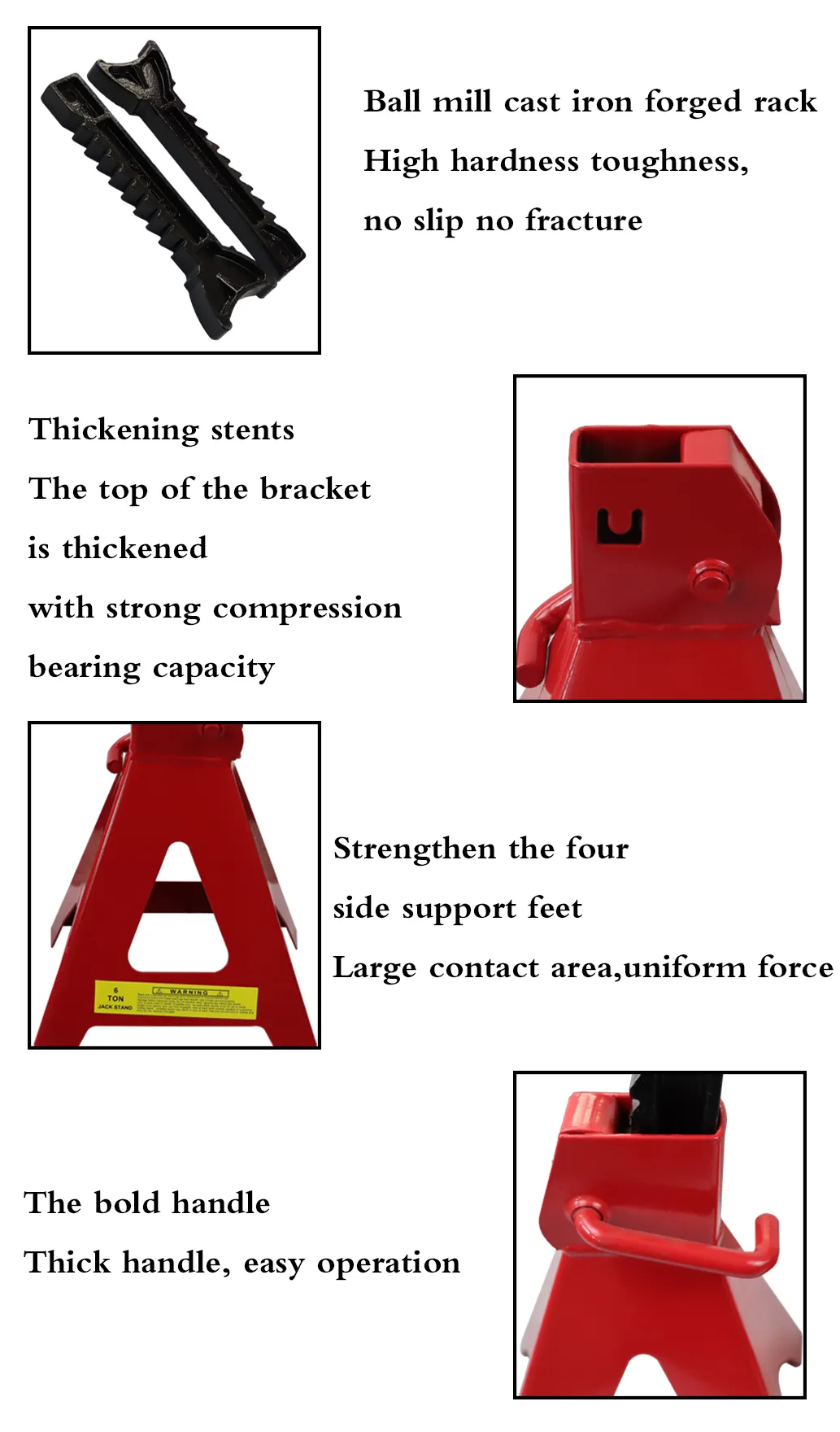
The predominant material used in wheel jack stand construction is carbon steel, specifically AISI 1045 or equivalent, due to its high yield strength and weldability. Raw material selection focuses on minimizing impurities and ensuring consistent chemical composition for predictable mechanical properties. Manufacturing typically begins with either forging or casting of the main structural components – the base, the upright, and the locking pawl. Forged components exhibit superior grain structure and therefore higher tensile strength compared to cast components, justifying their use in higher-capacity stands. Welding processes, such as Shielded Metal Arc Welding (SMAW) or Gas Metal Arc Welding (GMAW), are employed to join fabricated parts. Critical weld parameters – amperage, voltage, travel speed, and shielding gas composition – are meticulously controlled to prevent weld defects like porosity and incomplete fusion. Surface treatment typically involves phosphate coating to enhance corrosion resistance, followed by powder coating for durability and aesthetic appeal. The locking mechanism’s pawl is often manufactured from hardened alloy steel (e.g., 4140) and undergoes heat treatment (quenching and tempering) to achieve a Rockwell hardness of 55-60 HRC, ensuring resistance to wear and deformation under repeated loading. Parameter control during heat treatment is critical for achieving the desired hardness without compromising ductility and preventing brittle fracture.
Performance & Engineering
Performance analysis centers on the jack stand’s ability to withstand static and dynamic loads without failure. Force analysis reveals that the critical stress points are located at the weld joints, the locking pawl engagement surface, and the base’s contact area with the ground. Finite Element Analysis (FEA) is frequently used to simulate load distribution and identify areas prone to stress concentration. Environmental resistance is crucial; jack stands must resist corrosion from exposure to road salts, fluids, and moisture. Powder coating provides a barrier against corrosion, but the underlying steel’s corrosion potential must be considered. Stability is paramount, with a wide base design to resist tipping. The angle of the upright and the footprint of the base contribute significantly to overturning stability. Compliance requirements are driven by organizations like ANSI/ASME PASE-2014 (Safety Standards for Portable Automotive Lifting Devices), which dictates minimum load capacities, stability criteria, and material specifications. The locking mechanism’s design is critical; it must positively engage and securely hold the upright at the desired height, preventing accidental disengagement under load. Redundancy in the locking system – utilizing multiple pawls or a secondary locking feature – is a common engineering practice to enhance safety.
Technical Specifications
| Load Capacity (tons) | Minimum Height (in) | Maximum Height (in) | Base Width (in) |
|---|---|---|---|
| 2 | 11 | 16.5 | 8.5 |
| 3 | 13.3 | 19.7 | 9.8 |
| 6 | 16 | 24 | 12 |
| 10 | 18 | 29.5 | 14 |
| 15 | 21 | 36 | 16 |
| 20 | 24 | 42 | 18 |
Failure Mode & Maintenance
Common failure modes in wheel jack stands include yielding of the steel structure under overload, fatigue cracking at weld joints due to cyclic loading, and deformation or failure of the locking pawl. Fatigue cracking is exacerbated by pre-existing stress concentrators, such as sharp corners or poorly executed welds. Corrosion can weaken the steel, reducing its load-bearing capacity and accelerating fatigue crack propagation. Locking pawl failure typically manifests as wear or chipping of the engagement surface, preventing secure locking. Creep, the slow deformation of the steel under sustained load, can also contribute to instability. Maintenance involves regular inspection for signs of corrosion, weld defects (cracks, porosity), and pawl wear. Lubricating the pawl mechanism with a light oil or grease prevents sticking and ensures smooth operation. Jack stands should never be used if they exhibit any signs of damage or deformation. Overloading the jack stands beyond their rated capacity is a primary cause of failure and must be strictly avoided. Periodic recalibration of the locking mechanism is recommended, particularly in professional shop environments. Proper storage in a dry environment helps prevent corrosion.
Industry FAQ
Q: What is the difference between dynamic and static load capacity?
A: Static load capacity refers to the maximum weight a jack stand can support when applied slowly and consistently. Dynamic load capacity, which is usually lower, accounts for sudden impacts or movement. Jack stands are primarily rated for static loads, so exceeding this capacity, even momentarily, poses a significant risk.
Q: How important is the base width of a jack stand?
A: Base width directly impacts stability. A wider base provides a larger footprint, resisting tipping and increasing the jack stand's resistance to overturning forces, especially when working on uneven surfaces or vehicles with high centers of gravity.
Q: What type of steel is best suited for jack stand construction?
A: AISI 1045 carbon steel is a common choice due to its excellent balance of strength, weldability, and cost-effectiveness. For critical components like the locking pawl, hardened alloy steels like 4140 are preferred for their superior wear resistance and strength.
Q: What safety precautions should be taken when using jack stands?
A: Always use jack stands in pairs, positioning them on a level and solid surface. Ensure the jack stands are properly engaged and locked at the desired height before beginning any work. Never work under a vehicle supported only by a jack; jack stands are essential for safety. Never exceed the rated load capacity.
Q: How often should jack stands be inspected and maintained?
A: Jack stands should be inspected before each use for signs of damage, corrosion, or wear. Regular maintenance includes lubricating the locking mechanism and ensuring all components are functioning correctly. Damaged jack stands should be removed from service immediately.
Conclusion
Wheel jack stands represent a critical safety component in automotive maintenance, requiring rigorous attention to material science, manufacturing processes, and performance engineering. The selection of appropriate steel grades, precise welding techniques, and adherence to industry safety standards like ANSI/ASME PASE-2014 are paramount for ensuring reliable and safe operation. Understanding potential failure modes – fatigue cracking, corrosion, and pawl failure – and implementing a proactive maintenance regime are essential for maximizing the lifespan and safety of these vital tools.
Future development may focus on incorporating advanced materials like high-strength low-alloy (HSLA) steels and improved corrosion-resistant coatings. Integrated sensor technologies capable of detecting overload conditions or structural degradation could further enhance safety. Continued refinement of locking mechanism designs, prioritizing redundancy and positive engagement, will remain a central focus for ensuring the continued reliability of wheel jack stands.
