Introduction
The 3-ton hydraulic floor jack is a critical piece of equipment in automotive repair, heavy machinery maintenance, and various industrial applications. Functionally, it utilizes Pascal’s principle to amplify force applied to a small area (the pump piston) to a larger area (the lifting piston), enabling the elevation of substantial loads with minimal manual effort. Positioned within the lifting equipment supply chain, these jacks represent a foundational tool for professionals and informed DIY users alike. Core performance characteristics center around lifting capacity (3 tons/6000lbs), minimum lifting height, maximum lifting height, and operational safety features. A key pain point in the industry is ensuring consistent reliability and durability under repetitive, high-stress usage, particularly regarding hydraulic seal integrity and structural component fatigue. The market is saturated with varying quality levels, leading to concerns about long-term performance and safety for end-users.
Material Science & Manufacturing
The construction of a 3-ton hydraulic floor jack involves several key materials. The jack's body and lifting arm are typically constructed from high-strength carbon steel (AISI 1045 or equivalent), chosen for its weldability, tensile strength (approximately 570 MPa), and cost-effectiveness. The hydraulic cylinder is frequently made from honed steel tubing (typically AISI 1020) providing a smooth internal surface for piston travel. Piston seals are crucial; commonly manufactured from Nitrile Butadiene Rubber (NBR) due to its excellent resistance to hydraulic fluid and good abrasion properties. However, more demanding applications utilize Viton (fluoroelastomer) for enhanced temperature and chemical resistance. The hydraulic fluid itself is typically a mineral oil-based formulation, often containing additives to improve viscosity index, anti-wear properties, and corrosion inhibition. Manufacturing processes begin with steel plate cutting and forming, followed by robotic welding to create the main body structure. The hydraulic cylinder undergoes honing and internal surface treatment to minimize friction. Assembly involves meticulous fitting of seals, pistons, valves, and the pumping mechanism. Key parameter control during manufacturing includes weld penetration depth, tensile strength verification of steel components (via destructive and non-destructive testing), hydraulic fluid cleanliness (ISO 4406 standard), and leak testing of the assembled unit under pressure. Surface treatments, such as powder coating, provide corrosion resistance.

Performance & Engineering
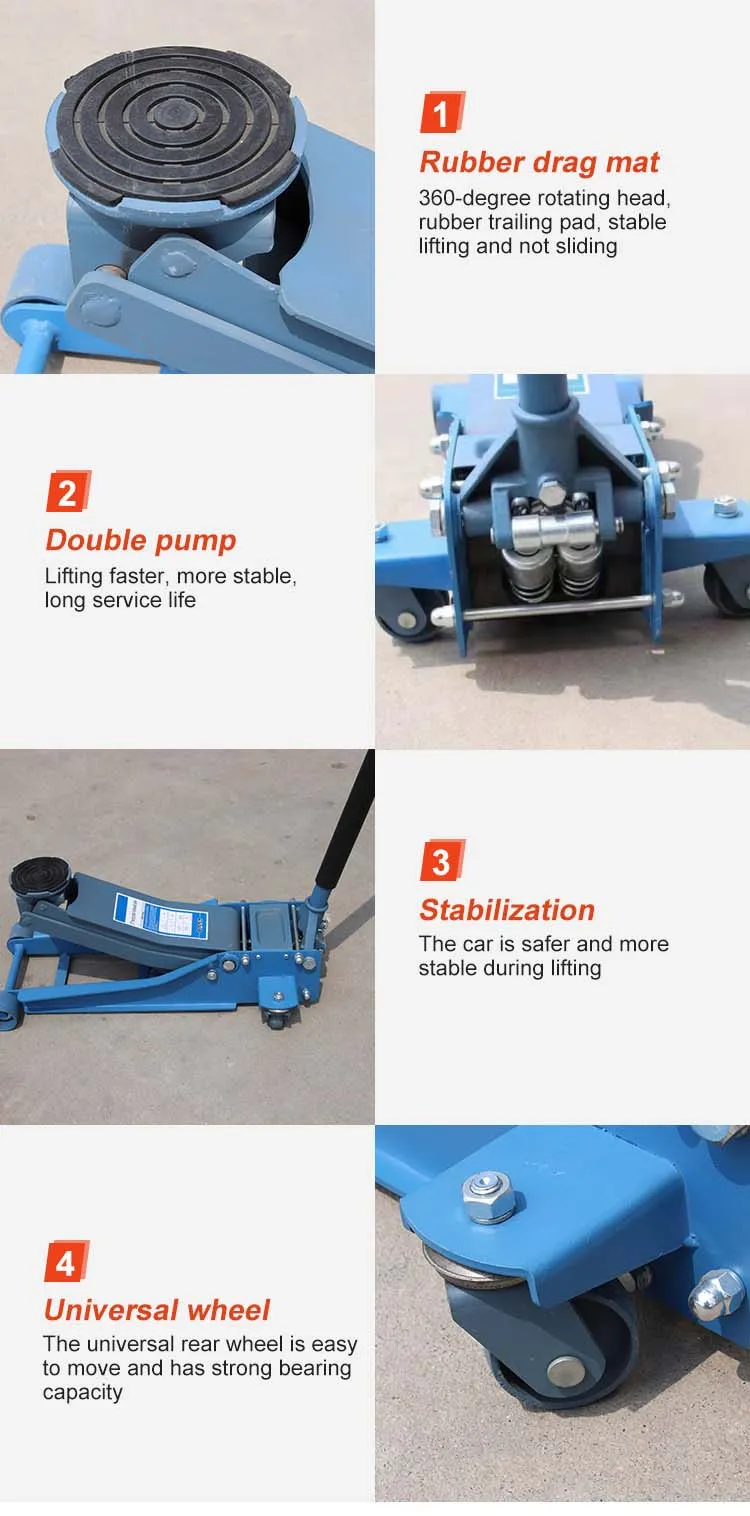
The performance of a 3-ton hydraulic floor jack is dictated by fundamental principles of fluid mechanics and structural engineering. The lifting force is determined by the ratio of the piston areas (large piston area / small piston area). Force analysis necessitates consideration of safety factors to account for dynamic loading and potential overloads. Environmental resistance is a critical consideration; exposure to moisture, dust, and temperature fluctuations can degrade seals and cause corrosion. The jack’s stability during operation is governed by its base design and center of gravity. A wider base and a lower center of gravity enhance stability, reducing the risk of tipping. Compliance requirements dictate adherence to safety standards (ANSI/ASME B30.1), which specify minimum safety factors, material specifications, and testing procedures. The internal relief valve is a crucial safety component, designed to prevent over-pressurization of the hydraulic system. Its calibration and response time are critical parameters. Engineering considerations extend to the handle design, aiming for ergonomic comfort and optimal leverage. Valve selection is also crucial for controlling the rate of ascent and descent, offering controlled lowering to reduce risks. Fatigue life is a significant concern, especially in high-usage applications, and requires careful consideration during component design and material selection.
Technical Specifications
| Parameter | Specification | Testing Standard | Typical Tolerance |
|---|---|---|---|
| Lifting Capacity | 3 Tons (6000 lbs / 2722 kg) | ASTM F1553 | ±5% |
| Minimum Lifting Height | 135 mm (5.3 inches) | In-house QC | ±3 mm |
| Maximum Lifting Height | 380 mm (15 inches) | In-house QC | ±5 mm |
| Pump Handle Strokes to Max Height | Approximately 5-7 | In-house QC | ±1 stroke |
| Hydraulic Fluid Type | ISO VG 32 Mineral Oil | ISO 3448 | Viscosity ± 5% |
| Steel Material (Body) | AISI 1045 | ASTM A570 | Tensile Strength ± 30 MPa |
Failure Mode & Maintenance
Common failure modes in 3-ton hydraulic floor jacks include hydraulic seal failure (leading to slow lifting or complete failure), piston corrosion (due to moisture contamination of the hydraulic fluid), structural cracking of the lifting arm (caused by overload or metal fatigue), and valve malfunction (preventing controlled lowering). Fatigue cracking typically initiates at stress concentration points, such as weld joints or sharp corners. Delamination of the seals results from degradation of the rubber compound due to exposure to heat, UV radiation, or incompatible fluids. Oxidation of the hydraulic fluid leads to increased viscosity and corrosion. Maintenance procedures include regular visual inspection for leaks, corrosion, and structural damage. Hydraulic fluid should be changed every 12-24 months, or more frequently in harsh operating environments. Seals should be inspected and replaced as needed. Lubrication of moving parts (e.g., pivot points) is essential to prevent wear and friction. Periodic testing of the relief valve is recommended to ensure proper functionality. Avoid exceeding the rated lifting capacity and always use the jack on a level, stable surface. Proper storage in a dry, clean environment minimizes corrosion and extends service life.
Industry FAQ
Q: What is the typical service life expectancy of a 3-ton hydraulic floor jack under moderate commercial use?
A: Under moderate commercial use (e.g., automotive repair shop with consistent but not excessive daily usage), a well-maintained 3-ton hydraulic floor jack can be expected to have a service life of 5-7 years. However, this is highly dependent on the quality of materials, manufacturing processes, maintenance frequency, and operating environment. Higher-quality jacks utilizing Viton seals and robust steel construction will typically exceed this lifespan.
Q: How does hydraulic fluid contamination affect jack performance and longevity?
A: Hydraulic fluid contamination is a major contributor to premature failure. Dirt, moisture, and air bubbles introduce abrasive wear, corrosion, and reduce the fluid's lubricating properties. This leads to seal damage, piston scoring, and decreased lifting efficiency. Maintaining fluid cleanliness (ISO 4406 cleanliness code) is crucial for optimal performance and longevity.
Q: What are the key differences between single-stage and double-stage hydraulic floor jacks?
A: Single-stage jacks provide a consistent lift rate throughout their range. Double-stage jacks offer a faster initial lift (low gear) for quicker engagement with the vehicle, followed by a slower, more controlled lift (high gear) as they approach the maximum height. Double-stage jacks generally require more pumping effort but offer increased efficiency for vehicles with higher ground clearance.
Q: What safety certifications should I look for when purchasing a hydraulic floor jack?
A: Look for jacks certified to meet ANSI/ASME B30.1 standards, indicating they have undergone rigorous testing and meet established safety requirements. Additionally, a CE marking (for European markets) confirms compliance with relevant European safety directives. Verification of third-party testing and certification is highly recommended.
Q: What type of hydraulic fluid is compatible with most 3-ton floor jacks, and what are the consequences of using an incompatible fluid?
A: Most 3-ton hydraulic floor jacks are compatible with ISO VG 32 mineral oil-based hydraulic fluid. Using an incompatible fluid (e.g., brake fluid, transmission fluid) can cause seal swelling or degradation, leading to leaks and complete jack failure. Always consult the jack's owner's manual for recommended fluid specifications.
Conclusion
The 3-ton hydraulic floor jack remains an indispensable tool across diverse industries, providing a safe and efficient means of lifting heavy loads. Its performance and longevity are fundamentally linked to material selection, manufacturing precision, and diligent maintenance. Understanding the principles of hydraulic operation, recognizing potential failure modes, and adhering to established safety standards are crucial for maximizing the jack’s operational lifespan and ensuring user safety.
Future developments in hydraulic floor jack technology may focus on incorporating advanced sealing materials (e.g., enhanced fluoropolymers) for increased durability, integrating smart sensors for overload detection and predictive maintenance, and exploring alternative hydraulic fluid formulations with improved environmental profiles. Ultimately, prioritizing quality, safety, and preventative maintenance will continue to be paramount in the effective utilization of these essential lifting devices.
