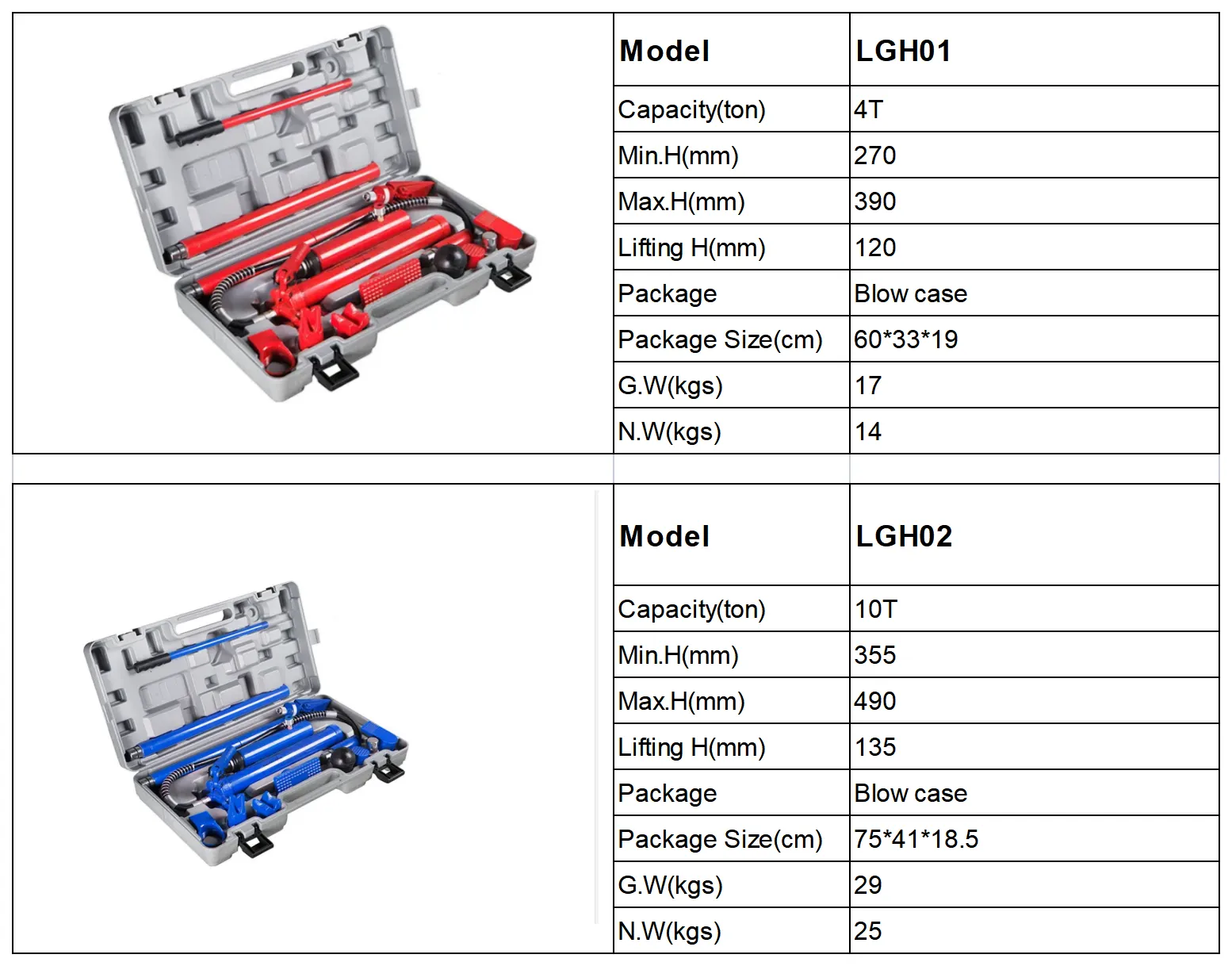
Introduction
The porta power hydraulic jack, a self-contained hydraulic spreading and lifting device, occupies a critical niche in industrial maintenance, emergency rescue, and construction applications. Distinct from traditional mechanical jacks, it utilizes Pascal's principle to generate substantial force from a relatively small input pressure. Positioned downstream from hydraulic pump and reservoir technology, its primary function is to apply controlled force for separating, lifting, or bending tasks where access is limited or precise positioning is paramount. Core performance characteristics are defined by rated tonnage, stroke length, and operational pressure, directly influencing its suitability for diverse applications ranging from vehicle extrication to structural steel alignment. The reliability and efficiency of these devices are increasingly important due to heightened safety standards and the demand for minimized downtime in industrial operations. Its portability and self-sufficiency render it a vital tool in situations where fixed infrastructure is unavailable.
Material Science & Manufacturing
Porta power hydraulic jacks predominantly employ high-strength steel alloys for critical components. Cylinder bodies and pump housings are typically manufactured from AISI 1045 or equivalent carbon steel, chosen for its machinability, weldability, and tensile strength. Piston rods utilize hardened and tempered alloy steel, often 4140 or similar, with a chromium plating to enhance corrosion resistance and minimize friction. Hydraulic fluid, commonly a mineral oil-based formulation with viscosity ranging from 32 to 46 cSt, is selected for its lubricating properties and stability across a wide temperature range. Manufacturing processes involve precision machining of cylinder bores and piston surfaces to ensure a tight seal and efficient hydraulic transfer. Welding, predominantly shielded metal arc welding (SMAW) or gas metal arc welding (GMC), is crucial for joining cylinder segments and reinforcing structural elements. Key parameter control includes maintaining tight tolerances on cylinder bore diameter (typically ±0.025mm), heat treatment processes to achieve desired hardness and ductility, and rigorous quality control checks for weld integrity, including non-destructive testing (NDT) methods like ultrasonic testing and dye penetrant inspection. Seal materials, typically nitrile rubber (Buna-N) or polyurethane, are vital for preventing fluid leakage and maintaining hydraulic pressure; their selection depends on fluid compatibility and operating temperature.

Performance & Engineering
The operational performance of a porta power hydraulic jack is fundamentally governed by Pascal’s Law: pressure applied to a confined fluid is transmitted equally in all directions. Force output is calculated as pressure multiplied by the effective area of the piston. Engineering considerations center around stress analysis of the cylinder and piston components under maximum load, utilizing finite element analysis (FEA) to identify potential failure points and optimize component geometry. Environmental resistance is addressed through material selection and surface coatings. Exposure to corrosive environments necessitates protective coatings like zinc plating or powder coating to prevent oxidation and degradation. Force vectors and load distribution are critical in application; improper loading can lead to instability or component failure. Compliance with safety standards (detailed in the footer) mandates the inclusion of pressure relief valves to prevent over-pressurization and potential rupture. The jack’s stability is further enhanced through a robust baseplate design, maximizing contact area and minimizing the risk of tipping. Fatigue life is a significant consideration, particularly in applications involving repeated cycling; material fatigue testing is conducted to ensure the jack can withstand a specified number of cycles at its rated capacity. The ergonomic design of the pump handle and release valve directly impacts operator efficiency and safety.
Technical Specifications
| Model Number | Rated Capacity (Tons) | Stroke Length (inches) | Operating Pressure (PSI) |
|---|---|---|---|
| PP-10 | 10 | 3.5 | 10,000 |
| PP-20 | 20 | 2.5 | 10,000 |
| PP-30 | 30 | 2.0 | 10,000 |
| PP-50 | 50 | 1.5 | 10,000 |
| PP-100 | 100 | 1.0 | 10,000 |
| PP-200 | 200 | 0.5 | 10,000 |
Failure Mode & Maintenance
Common failure modes in porta power hydraulic jacks include seal failure leading to hydraulic fluid leakage, piston corrosion due to moisture ingress, cylinder damage from overextension or lateral loading, and pump handle malfunction. Fatigue cracking can occur in the cylinder body or piston rod under sustained cyclic loading. Internal corrosion, often manifesting as pitting or rust, can compromise the integrity of hydraulic components. Failure analysis often reveals that seal degradation is accelerated by incompatible hydraulic fluids or operating temperatures exceeding the recommended range. Delamination of chrome plating on the piston rod can also lead to corrosion and reduced efficiency. Preventative maintenance is crucial for extending service life. Regular inspection for leaks, corrosion, and damaged components is essential. Hydraulic fluid should be replaced periodically (typically every 12-24 months) to maintain its lubricating properties and prevent sediment buildup. Pump handles should be lubricated regularly to ensure smooth operation. Following each use, the jack should be cleaned to remove dirt and debris. Storage in a dry environment minimizes the risk of corrosion. If leakage is detected, the seal should be replaced by a qualified technician. Do not exceed the rated capacity of the jack, and always use appropriate safety equipment, including eye protection and gloves.
Industry FAQ
Q: What is the impact of hydraulic fluid viscosity on jack performance?
A: Hydraulic fluid viscosity directly affects jack performance. Too low a viscosity can lead to internal leakage and reduced efficiency, while too high a viscosity can cause sluggish operation and increased energy consumption. The recommended viscosity range (32-46 cSt) is a balance between these factors, ensuring optimal performance across a typical operating temperature range.
Q: How do I determine the appropriate jack capacity for a given application?
A: Determining the appropriate capacity requires a thorough assessment of the load being applied. Always select a jack with a rated capacity that exceeds the maximum expected load by at least 20% to provide a safety margin. Consider the geometry of the load and the force vectors involved to ensure the jack is appropriately positioned and stable.
Q: What are the common causes of slow retraction speed in a porta power jack?
A: Slow retraction speed can be attributed to several factors, including low hydraulic fluid level, a worn or damaged release valve, internal leakage past the piston seals, or contaminated hydraulic fluid. Troubleshooting involves checking the fluid level, inspecting the release valve for obstructions, and potentially replacing the seals or flushing the system.
Q: Can a porta power jack be used in extreme temperatures?
A: While many jacks are designed to operate within a moderate temperature range (-20°C to 60°C), extreme temperatures can affect performance and reliability. Low temperatures can increase fluid viscosity and reduce efficiency, while high temperatures can degrade seals and reduce fluid lubricity. Specialized hydraulic fluids may be required for operation in extreme environments.
Q: What safety precautions should be taken when using a porta power jack?
A: Always wear appropriate personal protective equipment (PPE), including safety glasses and gloves. Ensure the jack is placed on a stable and level surface. Never exceed the rated capacity of the jack. Avoid applying lateral loads or attempting to use the jack for purposes other than its intended application. Regularly inspect the jack for damage or wear.
Conclusion
The porta power hydraulic jack remains an indispensable tool across a wide spectrum of industrial and rescue applications. Its reliance on fundamental hydraulic principles, coupled with robust material selection and manufacturing processes, ensures reliable and efficient performance. Understanding the underlying engineering principles – force amplification, stress analysis, and material compatibility – is critical for selecting the appropriate jack for a given task and maximizing its service life.
Ongoing advancements in material science, such as the development of more corrosion-resistant alloys and improved seal materials, will further enhance the durability and longevity of these devices. Continued adherence to industry safety standards and the implementation of comprehensive preventative maintenance programs are essential for mitigating potential failure modes and ensuring operator safety. Future development might focus on integrated pressure monitoring systems and improved ergonomic designs.
